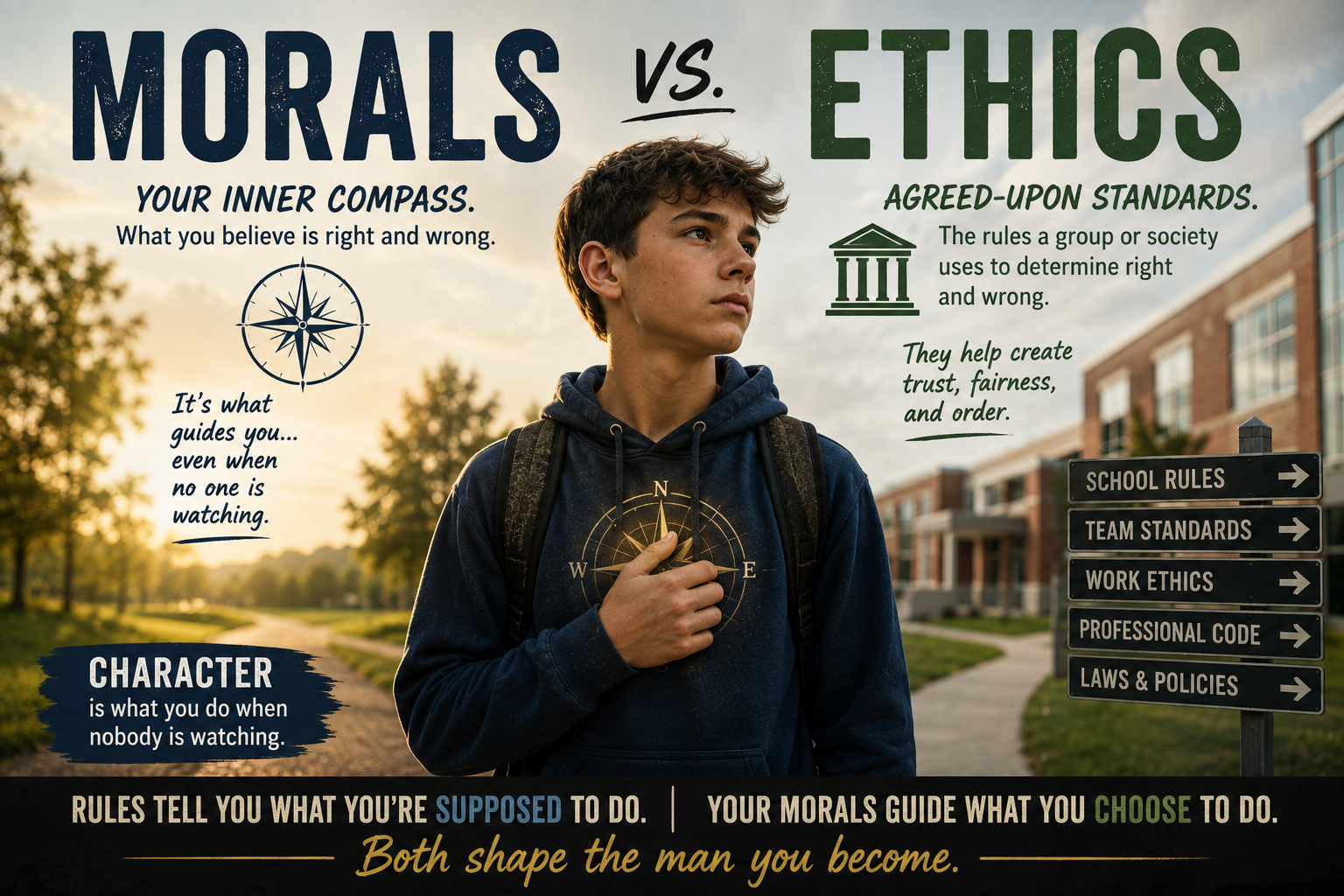
What is the difference between morals and ethics?
Those sound like words you might encounter in a philosophy class, but the difference is actually pretty simple.
Morals are what you believe is right and wrong.
Ethics are the standards a group, organization, profession, or society uses to determine right and wrong behavior.
Here’s an easy way to remember it:
Morals are your inner compass.
Ethics are the agreed-upon rules for the road.
Most of the time, the two point us in the same direction.
But understanding the difference can teach us something much more important about becoming a man of character.
The Golf Ball Nobody Saw Move
Imagine you’re playing golf with your friends.
You address the ball and accidentally cause it to move. Nobody else sees it.
What do you do?
The Rules of Golf tell you what you’re supposed to do. Those are the standards everyone playing the game has agreed to follow.
That’s ethics.
But there’s another question:
What do you do when nobody saw it happen?
That’s where morals come in.
If you believe cheating is wrong, you call the penalty on yourself.
Nobody had to catch you.
Nobody had to argue with you.
Nobody even had to know.
You knew.
That’s character.
The $20 Bill in the Hallway
Here’s another example.
You’re walking through school and see a $20 bill lying on the floor.
Nobody is around.
You could put it in your pocket, and there’s a pretty good chance nobody would ever know.
Your school probably has rules about returning property that doesn’t belong to you.
That’s an ethical standard.
But hopefully there’s also something inside you saying:
“That isn’t mine.”
That’s your moral compass.
So you turn it in.
Not because you’re afraid of getting caught.
Because you believe it’s the right thing to do.
Where Do Morals Come From?
Your moral compass doesn’t appear overnight.
It develops throughout your life.
Parents influence it.
Grandparents influence it.
Faith influences it.
Teachers influence it.
Coaches influence it.
Friends influence it.
Books and experiences influence it.
Eventually, though, you have to decide what you believe.
That’s an important part of growing up.
When you’re little, someone is constantly telling you:
“Do this.”
“Don’t do that.”
“That’s right.”
“That’s wrong.”
As you become a young man, something needs to change.
You begin taking responsibility for making those decisions yourself.
Ethics Matter Too
Ethics become increasingly important as you get older because almost every organization has standards of behavior.
Schools have them.
Sports teams have them.
Businesses have them.
Professions have them.
Doctors, lawyers, accountants, police officers, teachers, journalists, and countless other professions have ethical standards.
Why?
Because people need to be able to trust each other.
Imagine playing basketball if every player followed his own rules.
Imagine doing business with someone who changed the rules whenever it benefited him.
Standards allow people to know what is expected.
But rules alone aren’t enough.
You Can’t Write a Rule for Everything
There will never be a rulebook big enough to cover every situation you’ll encounter in life.
That’s why character matters.
Sometimes you’ll have to make a decision when there isn’t a teacher, coach, parent, referee, boss, or police officer standing nearby.
You’ll simply have to ask:
What’s the right thing to do?
That’s when your moral compass becomes important.
Your Friends Will Test It
One of the toughest tests of your moral compass will come from your friends.
Someone will eventually say:
“Come on. Everybody does it.”
Or:
“Nobody will know.”
Or:
“What’s the big deal?”
Those moments matter.
It’s easy to have principles when they aren’t costing you anything.
It’s much harder when doing the right thing might mean being laughed at, losing an opportunity, or standing apart from the group.
That’s where courage enters the picture.
Knowing what’s right is one thing.
Doing what’s right is another.
Build Your Compass Before You Need It
You don’t want to decide your values in the middle of a difficult situation.
Think about them beforehand.
Ask yourself:
What do I believe about honesty?
How important is keeping my word?
How should I treat people?
What will I refuse to do even if everyone around me is doing it?
What kind of reputation do I want?
And ultimately:
What kind of man do I want to become?
Those answers become your compass.
Final Thought
Morals and ethics aren’t just subjects for a classroom.
You’ll use them throughout your life.
Ethics provide standards for how we should behave.
Morals help us decide what we believe is right.
But character is where the two become action.
I’ve always liked a simple definition of character:
Character is what you do when nobody is watching.
There will be plenty of times in your life when nobody is watching.
No parent.
No teacher.
No coach.
No boss.
No referee.
Just you and a decision.
Make the choice you’ll be proud of when you look in the mirror the next morning.
That’s what becoming a good man is all about.
Leave a Reply