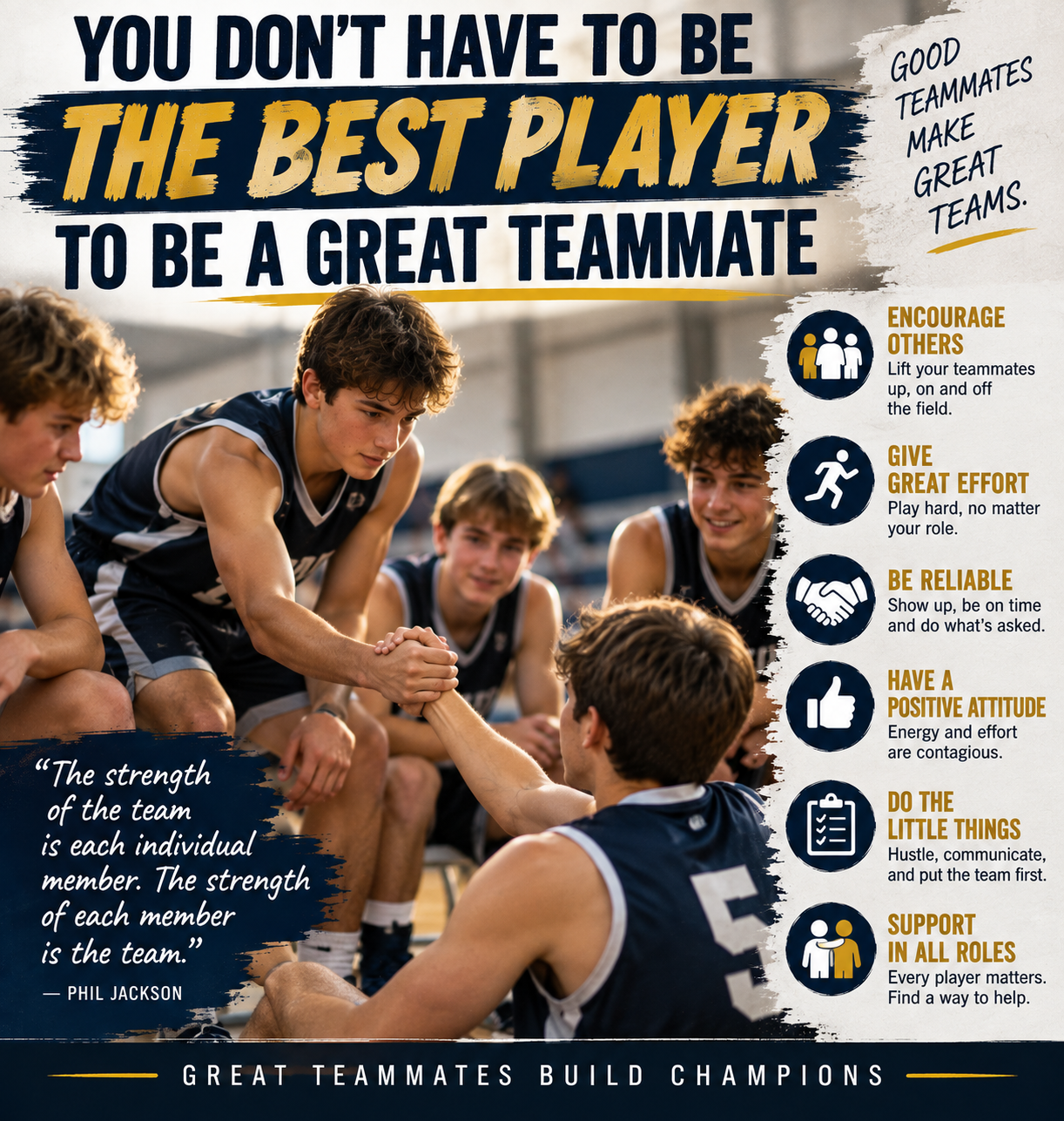
Sports have a way of making it easy to identify the stars.
They score the most points. Hit the home runs. Throw the touchdowns. Make the big saves. Their names get announced, their pictures get taken, and sometimes their accomplishments end up in the newspaper or on social media.
Every young athlete would like to be that guy.
But here’s something I’ve learned after spending many years around young men:
The best player on the team and the best teammate on the team are not always the same person.
Talent matters in sports. But so do effort, attitude, reliability, encouragement, sacrifice and character.
You may not be able to control whether you’re the most talented player on your team.
You can absolutely control what kind of teammate you are.
Your Role Still Matters
Every team needs stars.
But no successful team is made up entirely of stars.
Somebody has to play defense.
Somebody has to set the screen.
Somebody has to make the extra pass.
Somebody has to run hard in practice against the starters.
Somebody has to encourage the player who just made a mistake.
And sometimes somebody has to sit on the bench and be ready when his opportunity finally comes.
Those roles don’t always receive applause.
They still matter.
A good teammate understands that the team’s success is more important than his individual attention.
Effort Is Always Available
You may not be the fastest guy.
You may not be the tallest.
You may not have the best jump shot, strongest arm or quickest feet.
Some of those things are largely outside your control.
Effort isn’t.
You can hustle.
You can practice.
You can listen to your coach.
You can arrive on time.
You can learn your assignment.
You can give your best effort even when practice is difficult and nobody is watching.
Talent may determine some of your opportunities.
Effort determines what you do with them.
The Bench Is Part of the Team
This can be one of the toughest lessons in sports.
You want to play.
Of course you do.
If you didn’t want to compete, you probably wouldn’t be there.
But eventually almost every athlete experiences a time when he isn’t playing as much as he wants.
Watch what happens next.
Some players pout.
Some complain about the coach.
Some criticize the player ahead of them.
Some mentally leave the game before it’s over.
A great teammate does something different.
He stays engaged.
He encourages the guys who are playing.
He watches the game and learns.
And when the coach finally says, “You’re in,” he’s ready.
You can be disappointed about playing time without becoming a bad teammate.
Learning that distinction is part of growing up.
Celebrate Someone Else’s Success
This one can be difficult.
Your teammate gets the starting position you wanted.
He scores the winning basket.
He gets his picture in the paper.
Everyone congratulates him.
Meanwhile, you’re thinking:
I wanted that to be me.
That feeling is human.
What you do with it reveals your character.
Walk over and congratulate him.
Mean it.
One of the marks of maturity is being able to celebrate another person’s success without believing it diminishes your own.
There will be enough victories in life to go around.
Don’t Make Everything About You
Listen to athletes after a game and you’ll occasionally hear:
“I only got three touches.”
“Coach never puts me in.”
“I should be starting.”
Maybe they’re right.
But there’s another question worth asking:
What did I do to help my team today?
That’s a much better question.
Great teammates don’t constantly keep score of how much attention they’re receiving.
They look for ways to contribute.
Sometimes leadership means taking the shot.
Sometimes it means passing the ball.
And sometimes it means cheering for the guy who took your place.
Pick Up the Teammate Who Made the Mistake
Everyone eventually makes the mistake.
A missed free throw.
A dropped pass.
A strikeout with runners on base.
A missed assignment that leads to a score.
Your teammate already knows he messed up.
He probably doesn’t need you to remind him.
Walk over.
Pat him on the back.
Say:
“We’ve got you.”
Then move on to the next play.
Someday you’ll be the one who makes the mistake.
You’ll understand exactly how much those three words mean.
Make Your Teammates Better
Here’s a good way to judge your value to a team:
Are the people around you better because you’re there?
Do you bring energy to practice?
Do you encourage younger players?
Do you help someone who doesn’t understand a drill?
Do you compete hard without tearing down your teammates?
Do you make people want to work harder?
That’s leadership.
And you don’t need to be a captain to do it.
In fact, some of the most valuable leaders on a team never wear a captain’s letter.
Coaches Notice More Than You Think
Young athletes sometimes believe coaches only notice statistics.
Good coaches notice much more.
They notice who arrives early.
They notice who listens.
They notice who hustles when practice gets boring.
They notice who helps clean up equipment.
They notice who encourages teammates.
And they certainly notice who complains when things don’t go his way.
Your attitude is always on display.
Make sure it’s helping your team.
Sports Are Preparing You for Something Bigger
Eventually, the games end.
For almost all of us, there comes a day when nobody keeps score anymore.
But the lessons remain.
You’ll become an employee.
A husband.
A father.
A neighbor.
A member of a church or community organization.
You’ll be part of many different teams throughout your life.
And the same qualities will matter.
Show up.
Do your job.
Encourage others.
Put the group ahead of yourself when necessary.
Celebrate other people’s successes.
Take responsibility for your mistakes.
Help the people around you succeed.
Those aren’t just qualities of a great teammate.
They’re qualities of a good man.
Final Thought
If you’re the best player on your team, use your talent well.
Be humble.
Work hard.
Make everyone around you better.
But if you’re not the best player, don’t make the mistake of thinking you don’t matter.
Every team needs guys who can be counted on.
Guys who bring energy.
Guys who encourage others.
Guys who put the team first.
Guys who are ready when their opportunity comes.
You may not control how many points you score, how much playing time you get, or whether your name appears in the newspaper.
But every time you walk into practice, you get to make one important choice:
What kind of teammate am I going to be today?
You don’t have to be the best player.
Be the teammate everyone wants on the team.
— H. Douglas Knust
Author of the Man Stuff series
Leave a Reply